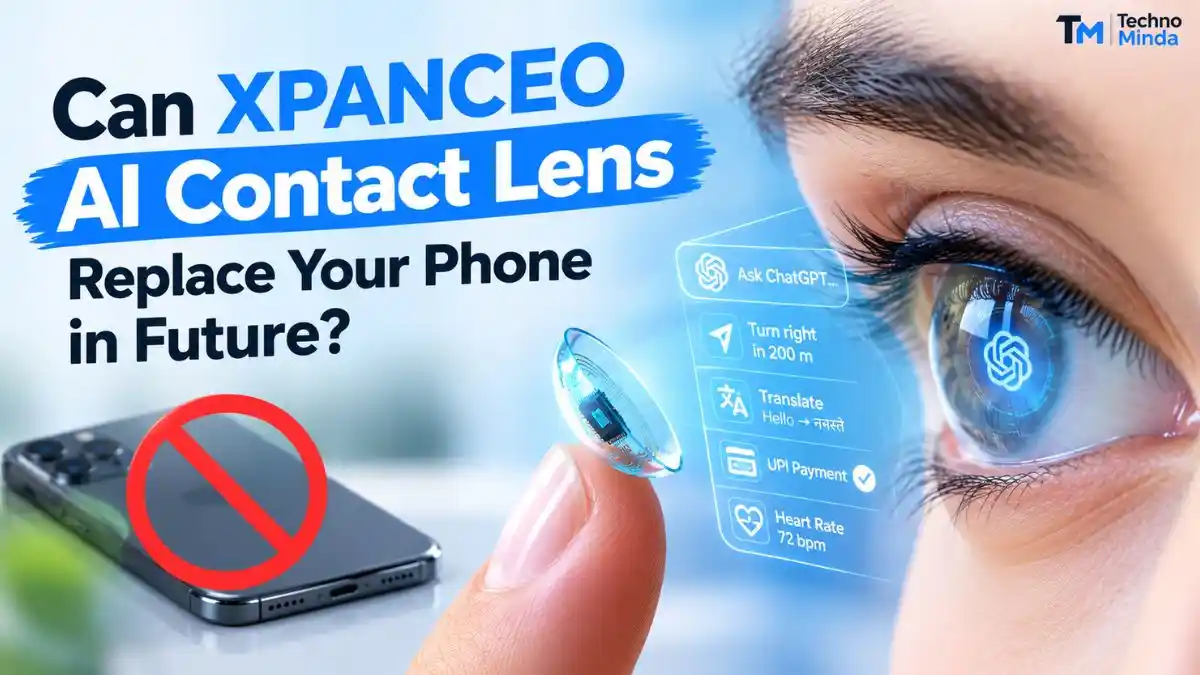
What if you could use ChatGPT in XPANCEO AI Contact Lens without taking your phone out of your pocket? What if you could view essential information right before your eyes and even make payments using a smart contact lens? It seems like a scene from a sci-fi movie, but a deep-tech company called XPANCEO is working on exactly this kind of smart contact lens technology that could transform how we use digital devices in future.
XPANCEO is developing displays, wireless power systems, health sensors and more for this smart contact lens. Can this technology really replace your smartphone? Can it display ChatGPT right in your field of vision or help you to make UPI payments? Let’s discuss, what XPANCEO is developing and what you need to know before believing the claims.
XPANCEO Smart Contact Lens, What Is It Exactly?
XPANCEO is a company working on developing smart contact lenses for AI. The difference between XPANCEO’s proposed technology and a standard contact lens lies in the integration of optics, electronics, sensors and wireless systems. Its goal is to create a lens that does far more than just correct your vision. XPANCEO has developed several prototypes to test various aspects of this technology like microdisplays, health monitoring systems, flexible electronics, wireless power and more.
In June 2026, the company announced that it is working towards demonstrating its first integrated smart contact lens prototype in early 2027. This is a crucial detail, this company is currently in the process of developing this technology, it does not mean that a fully functional smart contact lens is already available for purchase.
Can You Use ChatGPT Through Your Eyes?
This is the part that caught my attention. Imagine you are out for a walk and want to know something without pulling your phone out of your pocket. You could use a futuristic AI wearable to access information while observing scenes around you. You might want to translate a sign, get directions or simply ask the AI a normal question. A smart contact lens connected to a suitable display and computing system could potentially support such an experience.
We should not confuse a future technology concept with a preloaded ChatGPT product. XPANCEO is developing the hardware required for smart lens applications, like display and communication technologies, but there is no evidence that a commercially available XPANCEO contact lens currently runs ChatGPT directly in your eyes.
How Does the Display Work?
The biggest challenge is displaying an image so close to the eye. A smartphone has enough space for a large screen as well as other components. To be worn on the eye, a contact lens must be extremely thin and flexible. In July 2026, XPANCEO announced a partnership with JBD to develop a microdisplay specifically for smart contact lenses.
The companies had already worked on a proof of concept involving a microdisplay and an optical system capable of generating an image very close to the eye. The goal is to make digital information visible through future lenses without requiring bulky displays used in traditional AR glasses.
Battery Life Could Be a Big Problem.
Your smartphone has enough space for a relatively large battery. But a contact lens does not have this space. A smart lens needs to house tiny components within a very limited space while remaining comfortable and safe to wear. Powering the display, sensors and communication system is a genuine challenge. In April 2026, XPANCEO and ITEN announced a proof of concept for integrating a solid state microbattery into a smart contact lens.
The project focused on energy storage, encapsulation, wireless power and thermal considerations. XPANCEO also describes the use of a companion device to support power management and computing. This could be potentially useful because some processing and power related tasks could be handled outside the lens itself.
The Microbattery prototype does not guarantee that final product will offer all day battery life. The company will need to demonstrate how the battery, display, electronics and security systems function during daily use.
Can XPANCEO Smart Lens Make UPI Payments?
The idea of making payments via contact lenses is exciting, especially for those who regularly use UPI. Imagine scanning a QR code and making a payment without ever taking your phone out of your pocket. There is a significant difference between a lens that can display or recognize payment information and one that can securely complete a UPI transaction.
In 2024, XPANCEO showcased a smart contact lens prototype featuring a specific optical pattern for verification. The company outlined potential use cases such as payments, fund transfers, and access to restricted areas. This implies that payment security is one of the potential application areas the company has explored. This does not confirm that XPANCEO’s smart lens currently supports direct UPI payments. A functional UPI payment system would require secure authorization, user consent, reliable communication and compatibility with the relevant payment infrastructure.
Smart Contact Lenses for Health Monitoring
Smart contact lenses are not intended solely to replace smartphones. Health monitoring is another potential application where this technology could prove useful. XPANCEO has developed prototypes designed to sense health related data, like systems that analyze biomarkers in tear fluid. The company has also showcased technology related to glaucoma management and intraocular pressure monitoring.
In its 2026 announcements, XPANCEO described systems capable of transmitting sensor data to smartphones and exploring ways to support health monitoring. This is intriguing because future lenses could potentially gather information continuously, rather than relying on the intermittent measurements currently used.
Health technology requires rigorous testing. A prototype is not the same as a medical device intended for actual diagnosis or treatment. If these systems are eventually adopted by the general public, factors such as accuracy, safety, privacy and regulatory approval will be crucial.
Will Smart Contact Lenses Replace Smartphones?
This is a question many are asking. Personally, rather than assuming smartphones will vanish overnight, I believe it is more productive to consider which smartphone features might migrate to wearables. Future smart lenses could assist with quick information access, AI assistance, navigation or certain health monitoring tasks.
XPANCEO’s stated goal is to integrate multiple technologies into a single smart contact lens, offering a novel way to interact with digital information. Nevertheless, smartphones remain useful for a wide range of tasks. We rely on them for large screens, complex applications, video recording, gaming, file management and many other functions.
Even if smart contact lenses prove successful in the future, they might initially work alongside smartphones rather than completely replacing them. The actual outcome will depend on factors such as the lens’s comfort, safety, price, battery life, and reliability, as well as public perception regarding their utility.
When Will XPANCEO Smart Contact Lens Launch?
According to an announcement made by XPANCEO in June 2026, the company plans to publicly demonstrate its first integrated smart contact lens prototype in early 2027. This is a timeline for a prototype demonstration, not a confirmed launch date for a consumer product.
The company has already showcased various individual prototypes, but integrating them into a practical lens presents a different challenge. We still need further information regarding the final product, its availability, pricing, safety testing, battery performance, and daily usability. Hense I wouldn’t believe that the initial integrated prototype demonstration will immediately lead to a smartphone replacement available in stores.
My Thoughts on XPANCEO AI Contact Lens
The idea of using AI via contact lenses is certainly intriguing. We typically take out our phones, open an app, type a query and look at the screen. Smart contact lens technology could offer a different way to interact instead of constantly looking down at a screen, information could be displayed closer to our natural field of vision.
This technology still needs to address practical challenges. For me, comfort and safety are just as important as AI features. No one wants a smart lens that is uncomfortable, unreliable or difficult to use. Another concern is privacy. If a wearable device can see the world around you, people will want to know what information it collects and how that data is handled.
The concept holds potential, but it is too early to say that smart contact lenses will definitely replace smartphones.
XPANCEO is working on ambitious smart contact lens technology capable of integrating digital displays, AI-driven computing, health monitoring and wireless connectivity. The company’s 2026 announcements outline ongoing prototype development and a planned integrated prototype demonstration for early 2027.
The idea of having ChatGPT in your eyes or making UPI payments via contact lenses sounds exciting, but these claims should not be confused with the confirmed specifications of a finished consumer product. Now, if you are interested in the future of AI wearables and augmented reality, XPANCEO is a company worth watching.
Would you use this contact lenses if it could perform tasks you currently do on your phone? Share your thoughts in the comments and must follow TECHNO MINDA for latest updates.